
A Winter's Watch
Excerpt from my sequel novel

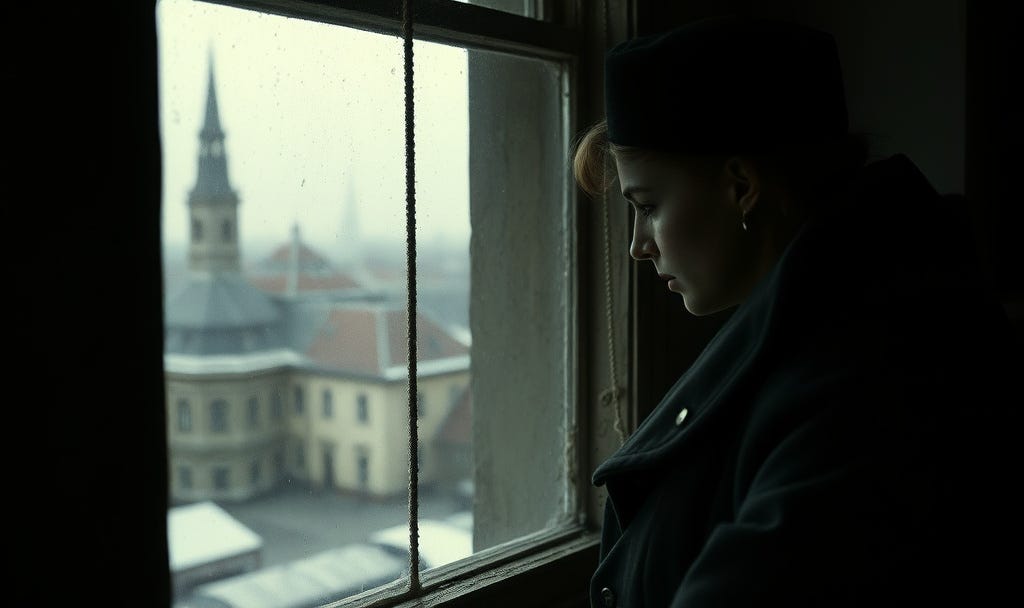
I flicked the apple core from the window sill; it tumbled into the snow-packed alley below. Between the buildings lay abandoned shacks and burned-out barrels from makeshift fires, the leftovers of people who’d fled in a hurry. German patrols, tighter city mandates, and the bite of approaching winter had pushed most folk elsewhere. I pitied them. I also wished they had the spine to fight back.
I checked my watch. 10:38. The guard change would be coming soon. A few soldiers huddled around a bin fire, its smoke curling up against the night. They looked miserable. I had no sympathy. The cold felt sharp on my exposed face, but I did not mind it. I took a small pull from my flask; the alcohol burned going down and warmed me all the same.
“Simone,” a voice called from the doorway. “Rudolph wants a report. Do you have anything this time?”
I rested my head against the weathered wood and let out a slow breath. My exhale fogged the air in front of me. “Why? It’s not even eleven. The guards are standing at trash fires, drinking, same as always. There’s no activity. Tell him to stop asking for updates.”
“Simone.” The voice hardened. “He wants what you have to report. You were gone nearly two days. All you can tell me is that soldiers are trying to stay warm? Come on. You’re better than that. And honestly, I don’t want to go back and tell him you have nothing. You’d be stuck with paperwork instead of reconnaissance, and we both know how much you’ll love being grounded in the basement.”
I turned to the young Polish Jew leaning in the doorway, arms crossed, the picture of thin patience. “Why are you his errand boy, Otto?”
“I’m not an errand boy.” He flared his nostrils.
“Seems like one to me,” I said. “But that’s not my concern.”
“You better mind your tongue, Simone, or I will—”
“You will what?” I cut in. “Run back to Rudolph and say I was mean to you?”
He sputtered, then fell quiet. Anger lit his eyes, but he fought for words. “Do you have a report or not?”
I fished a folded scrap of paper from my pocket and tossed it to him. “Two guard changes per hour now. They’re loading people from the eastern district onto the trains—probably five hundred more than usual. Curfew is enforced. Three public executions this week.”
“Christ.” Otto’s voice lost the edge of mockery. For a beat he sounded human with me again. “Things are getting worse.”
“Yeah.” I shrugged. “There’s not much we can do until an opening appears, if it ever does.”
“And you? How are you holding up?” he asked, softer.
I watched the first flakes begin to fall, turning the ruined skyline into something quiet and neat. The snow danced, indifferent to the war that gutted the city beneath it. Sometimes I wanted to be like that—let go, fall free, and know nothing of the mess below.
I closed my eyes and remembered the city before the war: Sunday evenings at a long table, my family laughing, my father telling stories. Those faces came back one by one—warm smiles, welcome eyes. I missed them every day. They were gone now. Otto and the others did not need to know that I had no family left.
How am I holding up? I wanted to shout. To tell him about the months of hollow anger, the faith I had lost, the single purpose that kept me afloat: revenge. I wanted to tell him I was a vessel emptied of everything but that mission.
Instead I forced a steadier voice. “I’m fine.” I knew he didn’t believe me. Who would? He opened his mouth as if to say something comforting and then stopped. We both understood that words would do little.
“Will you stay in the city much longer?” he pressed.
“As long as I need to.”
“There’s a rumor he won’t return to Warsaw,” Otto said. “Last seen in western Poland, heading for Germany.”
“And who says he won’t come back?” I asked. “This is his den. His home. He may be away serving his masters, but he won’t stay gone forever. It might take longer than we think, but he will return. That I promise.”
I swung my legs over the balcony and let them hang above the courtyard. Snow settled on my boots. Below, the guards mumbled around their fire, life reduced to small comforts and rote duty. I thought of the man I hunted, the name that ached in my chest whenever I let myself think of it. When he comes back,” I said, feeling the words like a blade in my mouth, “I’ll be ready. I’ll be the one who kills the Wolf of Warsaw.