
Moonlight Sonata

The remnants of the wine bottle lay scattered across the floor, its red contents pooling darkly on the concrete. I sank to my knees, burying my face in my hands as the weight of it all crashed over me.
“Where?” I croaked.
“Just beyond the hill,” Marcus replied, his voice tight as he fought back his own tears. “He sacrificed himself to save Claire and… the other.”
I looked up, eyes stinging, brow furrowed. “What do you mean?”
Marcus’s expression hardened. “Claire brought back a German boy.”
My grief twisted instantly into disbelief. I wiped my face and pushed myself to my feet. “Take me to him,” I ordered. “I must speak with him immediately.”
Marcus frowned. It was unlike me to give commands, especially in the midst of tragedy.
“I don’t think now’s the best time, Doc,” he said cautiously.
“Don’t tell me what’s good for me, Marcus!” I snapped. “Take me to him. Now.”
He hesitated, but eventually turned and led me through the narrow hallway to the cellar room. Before I entered, he caught my arm, his grip firm and eyes unwavering.
“Don’t do anything you’ll regret,” he warned. “We’re all grieving. We all want revenge. But don’t take it out on him.”
“I can’t promise that,” I said through clenched teeth. “But I’ll try.”
I pulled free of his grasp, stepped inside, and shut the door behind me. The lock clicked softly.
“Who… who are you?” a voice stammered in German from the corner.
“I’m the owner of this cellar,” I replied, turning toward him. “The others call me Doc.”
My German was rusty, but serviceable. When our eyes met, my anger began to fade almost instantly. He wasn’t the monster I’d imagined — not the power-hungry zealot painted by propaganda — but a boy. Barely twenty, if that. He sat curled against the far wall, trembling, waiting for me to strike.
I sighed and slid down the door, letting my legs stretch out before me. The exhaustion was too heavy to fight.
“I’ll be honest,” I muttered, removing my glasses to wipe them with a handkerchief. “Before I came in here, I intended to make you suffer.”
The boy shifted uneasily, gaze fixed on me.
“But now,” I continued, “I see you’re not what Marcus described. He said you were a German soldier, but I think he was mistaken.”
“I am a German soldier,” the boy said quickly.
“No,” I said, cutting him off. “You’re a misled youth. A pawn serving a cause you don’t even believe in — too afraid to defy it. You’d give anything to be home with your family instead of here, locked in a cellar, wondering if you’ll live to see tomorrow. You didn’t choose this war. It swallowed you.”
He frowned. “Why are you saying all this?”
I looked at him carefully. “Because I recognized you the moment I turned around.”
His brows knitted. “What do you mean?”
“You don’t remember me?” I asked, allowing a faint, humorless laugh. “I was there in the park during Claire’s execution. On the bench near her window. I told you where she’d be, what was supposed to happen. I was there when you killed that officer and ran — ruining my plan to free her.”
Realization washed over his face. His cheeks flushed. “I didn’t know you were trying to save her. I couldn’t let her die either. I took my own initiative.”
“You acted foolishly,” I said, though softer now. “Nearly got yourself killed. But… Claire is alive. And for that, I thank you.”
“She saved me, actually,” he said, voice barely above a whisper. “She convinced the officer to let me live.”
“Then perhaps I shouldn’t discredit you for bringing her home,” I replied. “Though Dmitri’s death weighs heavily on us all. You didn’t kill him, did you?”
His head shot up. “No! I tried to save him, but there were too many. He died saving us both.”
“I see.” I paused. “So, what do you think we should do with you?”
He blinked in confusion. “What do you mean?”
“Many believe you should face trial — that you represent every crime Germany has committed. They’d see you executed for it.”
The color drained from his face.
“However,” I continued slowly, “I intend to speak on your behalf.”
“Why?”
“Because I know what sacrifice looks like,” I said. “And I see it in you. You risked your life for Claire. That kind of courage is rare. I’d rather see that spirit used for good than wasted on revenge.”
He hesitated, then said, “And yet I’m still a German. How do you know I won’t betray you?”
“Because you’d never hurt Claire,” I said quietly.
He looked away.
“Tell me,” I pressed, “why do you care for her so much? Why not let her die that day? Why risk everything?”
“I fell in love with her the moment I saw her,” he admitted.
“Love?” I scoffed. “You’re a boy chasing the illusion of romance in a world that’s falling apart. Try again.”
He lowered his head, voice trembling. “Because she was innocent. None of this was her fault. And I was tired of standing by while innocent people were slaughtered. What my country is doing—it’s not right. I couldn’t watch it anymore.”
“And yet,” I said, “you joined the Hitler Youth willingly.”
“It wasn’t like that!” he shouted. “I was proud once, yes—but I didn’t understand. I believed what they told us. Until I saw the truth. Until I saw the faces of the people we destroyed.”
I stared at him for a long moment, then turned toward the door.
“I can’t promise your safety,” I said, unlocking it. “But thank you for bringing Claire home. For that, you have my gratitude.”
When I stepped out, Marcus stood silently by the wall. I nodded once, passing him without a word, and went to my office.
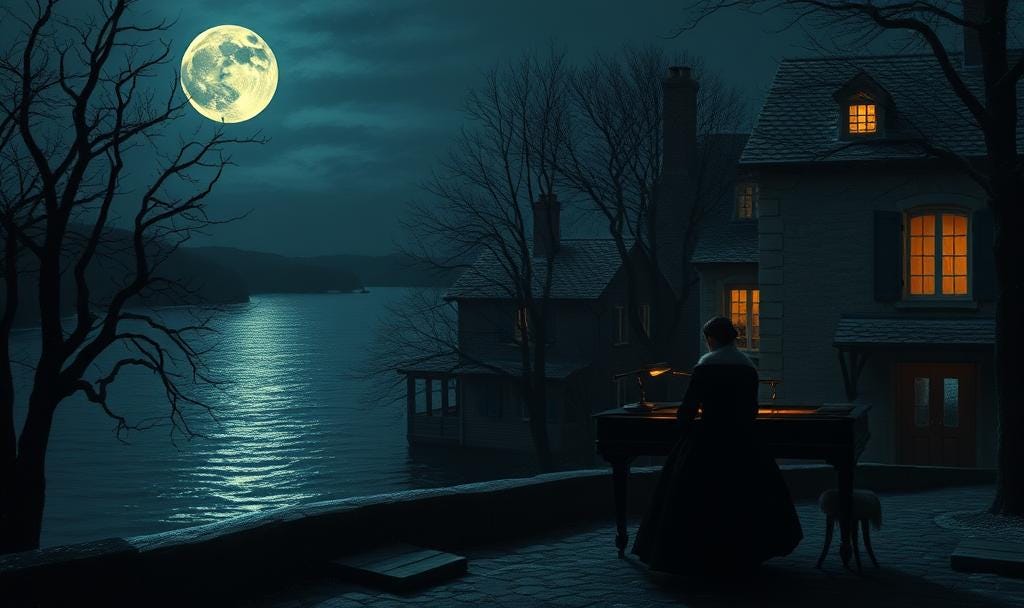
Inside, I placed a record on the player. The opening notes of Moonlight Sonata filled the air — slow, solemn, beautiful. I poured myself a glass of wine, the dark liquid catching the lamplight as I raised it to my lips.
The door creaked open behind me. I didn’t turn until I heard her whisper.
“Moonlight Sonata.” My wife’s voice trembled. “It was Dmitri’s favorite.”
She broke down before she could finish the sentence. I set my glass aside and rushed to her as she collapsed against the wall. Her grief was unbearable to watch — a mirror of my own.
I guided her to the couch, wrapped her in a blanket, and held her close. My chin rested gently atop her head, just as it had in younger, happier years — before the war, before the loss.
We sat in silence as the piano carried on, each note a lament for the world we’d lost.
When her breathing finally steadied, I whispered, “Everything’s going to be all right, darling. We’ll be all right… just wait and see.”